
| Newsletter Index | Publisher: Information Station Specialists | Subscribe to The Source |
| Editorial |
| "Nothing's Going to Happen to AM Radio That's Bad," President Predicts |
 |
| WASHINGTON, DC: This week, representatives of more than 30 state broadcast associations joined the National Association of Broadcasters inside the Beltway to advocate for action on the “AM for Every Vehicle Act” – legislation that has been idling in Congress for more than 3 years. In an unplanned exchange on Salem Media Monday, radio host Hugh Hewitt probed and the president responded, “We’re backing it 100%” and went on to indicate solid Executive Branch Support. The "AM for Every Vehicle Act" would keep AM Radio accessible in all new vehicles sold in the United States for eight years after approval. The Act has been passed by various committees and has been included in other pieces of legislation since its inception in 2023 but has never been brought to a floor vote, despite overwhelming bipartisan support. Perhaps now, lawmakers can be convinced to step on the gas . . . rather than the brake. |
 |
| Passes with Flying Colors |
| Compact Magnum k1 AM Antenna Enters Market: a New Option for Broadcasters Who Had None |
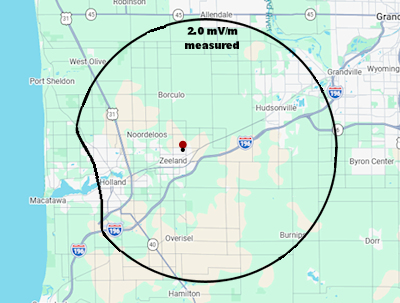
| ZEELAND, MI: Engineers who once might have looked side-eyed at alternate AM antenna designs are looking again. Information Station Specialists began field testing the Magnum k1 Antenna under an experimental license in the dead of the winter; and this summer its performance came up roses for the company that advertises itself as “The Radio Source.” The antenna’s compact design allows it to function at less than 50 feet height from a parcel of land – or flat roof – only 100 feet square. Operating at 1 kW on AM 1550 from a Nautel J1000 Transmitter, the antenna has put down a test signal that is turning heads. The broadcast location sits on a natural boundary between West Michigan beach sand and inland clay. The city-grade signal predictably propagates much farther into the conductive 8.0 mS soil – more than 12 miles – and even punches 7 miles into the sandy 2.0 mS soil along the shore. The measured efficiency is such that a broadcaster can employ it as a fulltime solution on frequencies north of 900 kHz. The Magnum k1 Antenna is the newest entry in a cluster of antennas and transmitters the company offers for temporary broadcast (STA) and low power applications. You may email Information Station Specialists to obtain a no-charge assessment of the Magnum k1’s signal efficiency for your station. |
 |
| Roosevelt Library Debut Relies on Radio |
| MEDORA, ND: The North Dakota Department of Emergency Services rolled out two RadioSTAT portable emergency stations for this month’s July 4th opening of the Theodore Roosevelt Presidential Library, an international-scale event that had the potential to overload transportation and communications in the prairie town of Medora. The $450 million project drew an estimated 13,000 people in approximately 4,400 vehicles to the town – which boasts a year-round population of only 121, according to the 2020 census. Radio stations directing travelers were strategically located west of the city at Beach, ND, and east at Belfield, ND, on Interstate 94. The stations served static messaging for eastbound and westbound visitors and passers-through on Interstate 94. A third RadioSTAT, with a cellular-based link to its internal message player, served dynamic messaging to the Medora area on its own adjacent frequency. |
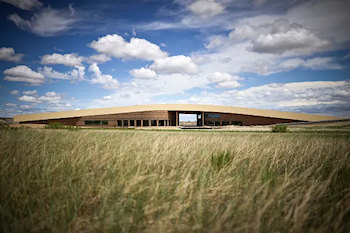 |
| Photo by Chad Ziemendorf Courtesy of Theodore Roosevelt Presidential Library's Matt Briney |
| Utilizing the challenging topography of the Badlands of North Dakota as a buffer instead of an obstacle to be overcome, the stations’ strategic placement allowed them to achieve outstanding coverage in their assigned area without interacting with each other, according to Clint Fleckenstein of the North Dakota Department of Emergency Services. Additionally, the July events allowed North Dakota to add extreme heat to the conditions in which these units have been deployed, complementing service during bitter Great Plains winters. |
| LA Communities Bulk Up |
| Adding AM Radio to Safety Arsenals |
| LOS ANGELES, CA: In the wake of last year’s fires, area Emergency Managers are making sure a safety net is in place for the next time a disaster strands residents without power and / or cell communications. Rancho Palos Verde, a shoreline Community south of Los Angeles, brought their service on line this spring after a year of planning and preparation. The radio signal covers their city as well as surrounding communities to the north and east on the Pacific shore. |
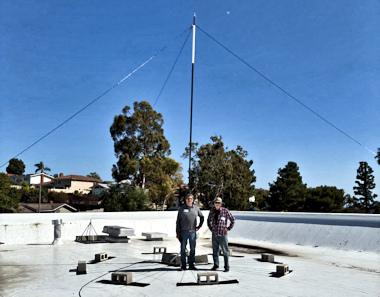 |
| Los Angeles area’s Rancho Palos Verdes completed installation of the City’s new AM Emergency Advisory Radio Station on May 14th. |
| Pictured L-R are the City's Gary Lopes & Wouter van Biene |
| * * * |
 |
| San Bernardino County Safety Managers in operational training on a new portable station. |
| Photo by Kort Waddell, Restless Natives Productions |
| San Bernardino County emergency managers deployed an additional RadioSTAT Portable AM Station to communicate with residents when power / cell is lost. The County’s stations leverage Starlink for control, making their operation independent of cellular services. New and upgrades to existing Emergency Radio Stations are also in process in the nearby communities of Jurupa Valley, Lakewood, Grand Terrace, Eastvale and Monrovia and Riverside County. Recent article: LA-rea fires in The Source Newsletter, Jan 2025. |
PO Box 51, Zeeland, Michigan, USA, 49464-0051, Phone 616.772.2300, Email
• • •