 |
| Oregon Information Station Boasts Far-Out Listeners |
| This 4,000+ mile listening report probably breaks some kind of 10-watt AM radio reception record. |
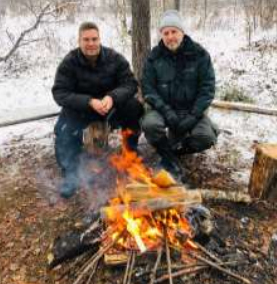 |
| Jim Solatie (left) and Jari Ruohomaki "Keeping Warm" |
| REPOJOKI, FINLAND: There may not be a lot going on in Finland on a frosty morning in October, so why not try and tune your radio and see what’s happening in America? Or anywhere else on the globe, for that matter? That’s the hobby of Jim Solatie and Jari Ruohomaki of the Finnish Radio Listeners Club, who have strung more than a half mile of wire near Repojoki, Finland, to create a medium-wavelength “DX antenna” for the purpose of picking up far-away signals. On the morning of October 19th, they pulled up a faint signal on 1610 AM, and to their delight, it was Beaverton, Oregon’s, 10-watt Information Station WSMF449. They promptly emailed the City to report the freak “skywave” reception. Jim and Jari's club has logged reception of 10-watt stations operated by Caltrans (1610 AM), Travis Air Force Base (1710 AM) and a dozen others over the years, as well. |
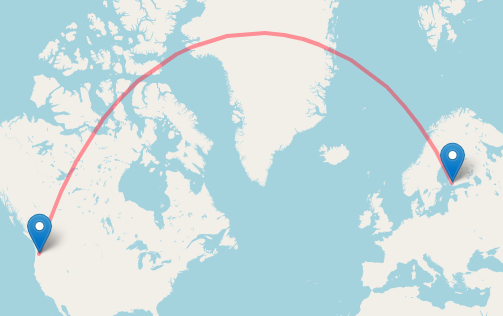 |
| Repojaki, Finland, located 200 miles north of the Arctic Circle, is not exactly in Beaverton’s neighborhood. It's 4,402 miles away as the snowy owl flies. But when the ionosphere cools at night, AM signals can bounce to great distances and are most detectable on channels without lots of broadcast stations (e.g., 530 kHz and 1610-1710 kHz). “Hearing WSMR449 all the way over here was a wonderful surprise, and we hope you will enjoy learning how far your signal traveled,” wrote Solatie and Ruohomaki. See Jim Solatie's YouTube channel. |
 | |
| Taking Communication to the Situation | |
| Emergency Management Agency Plugs Portable Radio Station into its Communication Mix in Preparation for "Next Time" | |
| SANFORD, FL: Central Florida was not targeted by a major hurricane this fall, but planners know change will be in the wind someday soon. They are getting ready now, because that’s what they do, Seminole County OEM Recovery Coordinator Benjamin Duenas advised The Source. Dotted with lakes, rivers, forests, developments and urban neighborhoods north of Orlando, the large County is implementing a portable radio service to reach residents and vulnerable populations when accurate information might be hard to access – “a dependable way to reach a community when other communication systems are disrupted,” Duenas explained. Lake and river flooding from storms is the most likely hazard due to the County’s flat geography. But which part of their 30 by 20 mile jurisdiction will be impacted? The portable RadioSTAT system allows emergency managers to set up a signal 10 miles in diameter quickly in the specific area where an operation is being initiated. "By delivering clear, location-specific guidance, the RadioSTAT unit helps ensure that residents know where to go for supplies, assistance and support during both response and recovery phases,” Duenas added, ”broadcasting locations and hours for Points Of Distribution (PODs), disaster recovery centers and other critical post-disaster resources. The unit is especially valuable for low/fixed-income communities that might be disproportionately affected by disasters and communication outages.” | |
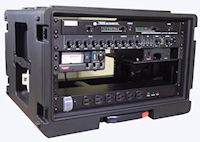 | 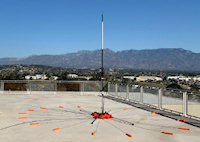 |
| RadioSTAT Portable Radio Electronics and Antenna System Operating from a Building Roof during COVID for a Drive-Thru Clinic in California | |
| The County also intends to light up the system during preparedness exercises and community events. Comments Duenas, “This will be a valuable communication asset year-round.” | |
| EDITORIAL |
| Americans to Car Makers: "Not So fast. . ." |
 |
| DETROIT, MI: One thing most all Americans are voting for: they want a radio receiver in their car’s dashboard. The popular bill before Congress that mandates AM receivers in cars has broad bipartisan and public support. Meanwhile, automakers and related groups who have come out opposed to the bill have spent more than $6.3 million recently lobbying congress. Their end-game is reportedly to sideline all dashboard radio receivers – both AM and FM – so they can charge us for in-car audio subscription services. All the while, terrestrial broadcasting remains our steadfast safety net in a national catastrophe; many of our highest-powered AM and FM stations are now hardened for that eventuality. And, as Edison Research studies note, AM/FM listening time in cars accounts for the largest percentage of any medium. So, it is hardly a surprise when a new survey suggests that for car makers who decide to remove radio, buyers will consider voting with their feet. A Critical Mass Insights survey reports that 89% responded that the lack of an in-car radio would likely keep them from buying a particular model. Have car manufacturers ceased caring about public opinion? Hardly. They are just running their own election – quietly voting to monetize our dashboards, hoping we will not notice when safety appears in our rear-view mirrors. ^^^^^^^^^^^^^^^^^^^^^^^^^^^^^^^^^^^^^^^^^^^^^^^^^^^^^ Tell your Congressman to pass the "AM for Every Vehicle Bill" by texting “AM” to 39179. |
* * *
| DX Engineering Picks Up 630-Meter "The Lowdown" HAM Radio Antenna |
Information Station Specialists – The Radio Source – is pleased to announce that the national leader in Amateur Radio products and services – DX Engineering – is now offering “The Lowdown” 630-Meter HAM Radio Antenna, along with accessories like mounts, matching transformers, stands and groundplanes, to its international marketplace. The antenna allows amateurs to transmit and receive on the new HAM radio band at 472-479 kHz and uniquely allows for fixed or portable operation on that very big wavelength… from a very small space. See The Lowdown Antenna at DX Engineering’s website. |
PO Box 51, Zeeland, Michigan, USA, 49464-0051, Phone 616.772.2300, Email
• • •