
| A Bridge to Passage? |
| The 'Save AM Radio' Bill Could Be Loaded into 'Build America 250' Legislation |
 WASHINGTON, DC: Despite broad bipartisan support and even West Wing buy-in, the “AM In Every Vehicle Act” has been stalled since its introduction more than two years ago. But on Thursday, May 21st, National Association of Broadcasters President and CEO Curtis LeGeyt congratulated the House Committee on Energy and Commerce for including the bill’s language in the pending Motor Vehicle Modernization Act of 2026 (HR 7389). “...Ensuring continued access to AM radio in vehicles remains essential for public safety,” he stated. The Act may ultimately be included in the Build America 250 Act, which is expected to come up for a vote on the House floor soon. WASHINGTON, DC: Despite broad bipartisan support and even West Wing buy-in, the “AM In Every Vehicle Act” has been stalled since its introduction more than two years ago. But on Thursday, May 21st, National Association of Broadcasters President and CEO Curtis LeGeyt congratulated the House Committee on Energy and Commerce for including the bill’s language in the pending Motor Vehicle Modernization Act of 2026 (HR 7389). “...Ensuring continued access to AM radio in vehicles remains essential for public safety,” he stated. The Act may ultimately be included in the Build America 250 Act, which is expected to come up for a vote on the House floor soon.Lawmakers in disaster-impacted areas stated their support more pointedly. Rep Darren Soto of Florida: “A lot of times all … these systems fail, and you just go out to your car and you get to hear key information that saves lives.” Florida Representative Gus Bilirakis added, “As we head toward hurricane season, all those on the East Coast and across the Gulf should be confident in knowing they can receive emergency messages through AM radio…” |
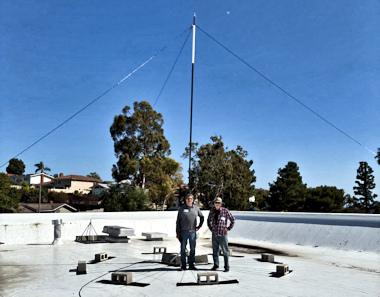 |
| Los Angeles area’s Rancho Palos Verdes completed installation of the City’s new AM Emergency Advisory Radio Station on May 14th. (Pictured L-R are the City's Gary Lopes and Wouter van Biene) |
| Photo by Tom Coviak, Information Station Specialists |
| The eyes of the nation's AM broadcasters as well as those of government agencies that utilize the medium for local emergency information have been focused on the progress of the AM legislation since it first appeared as a reaction to automakers' attempts to sideline the band from new car dashboards. But due to an upwelling of public response, larger US car makers had to put their efforts into reverse, continuing to include AM receivers, even in electric models. |
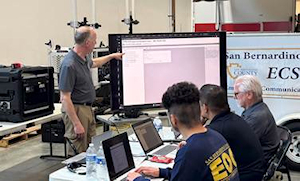 |
| April 2026: San Bernardino County emergency managers train to deploy an additional portable RadioSTAT AM station to communicate with residents when power / cell is lost. The stations leverage Starlink for control, making their operation independent of cellular services. |
| Photo by Kort Waddell, Restless Natives Productions |
| Even so, the use of the legacy band as a conduit for critical information continues to increase. A dozen Los Angeles area communities impacted by fires are adding or upgrading Emergency Advisory Radio Stations. California Rep Raul Ruiz cited the Camp Fire that devastated Paradise, CA, as an impetus: “Cell towers were immediately overwhelmed” as residents fled. “AM radio was one of the only sources for real-time information.” See Emergency Advisory Radio Solutions for government agencies and their partners. Located in the Puget Sound west of Tacoma, WA, Fox Island was granted a license in May to use Emergency Advisory Radio should an event compromise their only bridge to the mainland or sever cellular or power services. Communities in the western Carolinas are proposing similar systems after experiencing the wrath of recent hurricanes. Our nation’s big-coverage AM stations compose the backbone of the US’s Emergency Advisory System (EAS), recently hardened to survive a national emergency. |
PO Box 51, Zeeland, Michigan, USA, 49464-0051, Phone 616.772.2300, Email
• • •